
Railroad strike threatens South Dakota communites
ABERDEEN, S.D. – After a long shift, 16 hours in total, it’s time for conductor Logan Johnsen to head home. Even though he just worked overnight into mid-morning he still has to drive home and make the choice to eat, shower, or go straight to bed.
“Feeling rested is a long-forgotten idea for me,” Johnsen said. “With this new contract agreement and the points system the carrier implemented I don’t see how it will get any better.”
Johnsen faces the threat of a strike. Johnsen knows can’t cross the picket line if the strike occurs, but he worries about how his friends that farm will fare if the railroad stops transporting goods.
The multi-billion-dollar company, Burlington Northern Santa Fe has a terminal in Aberdeen, with several other terminals scattered through the state. In total over 1,000 South Dakota workers keep the local and national supply chain afloat. But another failed round of collective bargaining leaves the Class I rail carriers and their workers at odds.
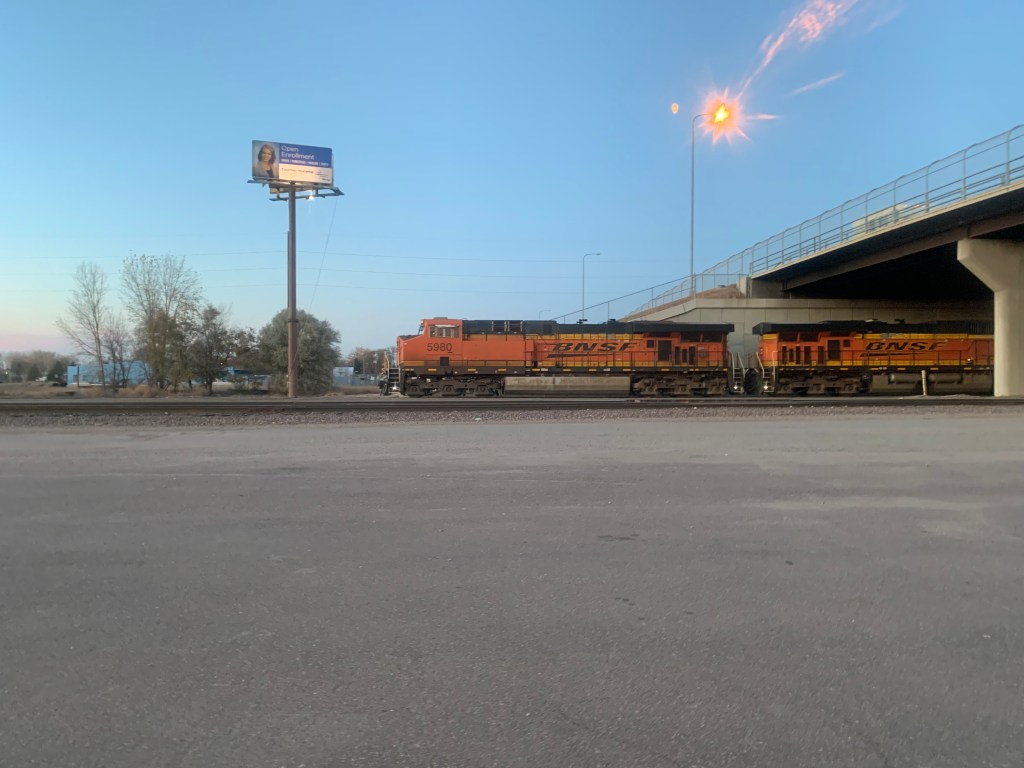
A loaded grain train sits outside of the local terminal in Aberdeen, South Dakota. The train is headed west with grain from local grain elevatiors to ports in Washington state. Photo by Moriah Williams.
“This really isn’t good,” said Connie Bruemmer, an ethanol buyer for the local Harms Oil Company. “If the local railroad workers strike, the local ethanol plants have to shut down production, and we can’t get ethanol fuel to the gas pumps.”
According to Bruemmer, Harms has to play the long game and develop plans if the ethanol facilities lack train cars to ship their product.
“If AGP or Glacial Lakes don’t have the trains coming in around the clock, they have to depend on small fleets of semi-trucks to ship the ethanol,” Bruemmer said. “And the capacity just isn’t there to support the demand.”
According to Bruemmer, any time there is a lack of outflow from the ethanol plants, people get laid off.
“So many of the Aberdeen community is employed by places like AGP and Glacial Lakes,” Bruemmer said. “If the strike last longer than a week, people would be out of work in an already tight economy.”
South Dakota Soybean Processors CEO, Tom Kersting, lent his voice to the ongoing rail strike debate.
“Rail drives this country,” said Tom Kersting, South Dakota Soybean Processors CEO. Kersting said that a disruption to shipping would be a detriment to farmers and the industry as a whole.
“I don’t think people realize how important this is,” Kersting said. “Even a very short strike sis going to be very bad.”
Kersting said that a strike, could create a major backlog during harvest, as grain elevators would struggle to create space for millions of tons of crops.
It’s 10 p.m. and Johnsen is getting his bags packed to go on another overnight trip. He had to cut his sleep short, because his wife wanted to take fall pictures. He said he often sacrifices sleep to spend time with her.
“I try to get six hours of sleep,” Johnsen said. “I can sleep in a hotel, but I can’t get back lost time with my wife.”
Johnsen said the biggest win that could be accomplished by an agreement being reached between the unions and the carriers, is conditions that would attract more employees.
“Watching your life slip by on a train, makes you realize how much of your life you miss when you aren’t home,” Johnsen said.
 Moriah Williams